

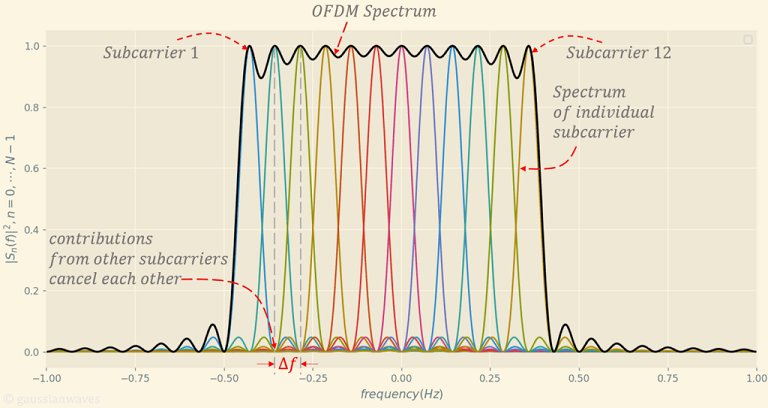
OFDM (Orthogonal Frequency Division Multiplexing) is the data transmission technique used by the IP400 mesh network to raise the bar on conventional data rates. This is accomplished by implementing a number of sub-carriers, with uniform spacing, bundled together in a spectral space to facilitate the transmission of large amounts of data. It is the modulation method of choice for modern-day communications systems, including cellular telephones, cable modems and digital subscriber lines.
OFDM-AB (Amateur Bands) is a creation of society members that uses the audio range of a transceiver and is independent of the band or on-air transmission mode. It can operate on any amateur band from 10m to 1296MHz, utilizing FM on air. Connection to the radio, for lower data rates, is through the microphone and speaker connections, or for higher speeds, a dedicated data port.
Modes
The OFDM carriers occupy the audio bandwidth of the radio, and four different modes have been defined, the smallest is compatible with most radios and can be connected to the microphone and speaker connections, and the largest can be used with radios with flat audio passbands and data ports. All modes use 12.5KHz spacing. The table below shows the mode names and bandwidths.
| Mode | Band width | Application | Radio Connection |
|---|---|---|---|
| Narrowband | 2,625 | Most FM Radios | Mic and Speaker |
| Enhanced Narrowband | 3,656 | Radios without sharp high end cut-off | Mic and Speaker |
| Wideband | 5,766 | Radios with data ports | Data Port |
| Enhanced Wideband | 7,781 | High end radios with extended passbands | Data Port |
Data Rates
The data rates will vary depending on the mode and the carrier modulation method, referred to as the constellation, as it resembles a star map. The lowest method, Binary Phase Shift keying (BPSK), sends one bit per carrier, whereas the highest, Quadrature Amplitude Modulation with 256 data points (QAM-256) sends 8 data bits on each carrier.
| Constellation | Bits | NB | ENB | WB | EWB |
|---|---|---|---|---|---|
| BPSK | 1 | 2,426 | 3,353 | 5,294 | 7,147 |
| QPSK | 2 | 4,853 | 6,706 | 10,588 | 14,294 |
| QPSK-8 | 3 | 7,260 | 10,059 | 15,882 | 21,441 |
| QAM-16 | 4 | 9,680 | 13,412 | 13,412 | 28,588 |
| QAM-32 | 5 | 12,132 | 16,765 | 16,765 | 35,735 |
| QAM-64 | 6 | 14,520 | 20,118 | 31,765 | 42,882 |
| QAM-128 | 7 | 16,940 | 23,471 | 37,059 | 50,029 |
| QAM-256 | 8 | 19,360 | 26,824 | 42,353 | 57,176 |
Transmission
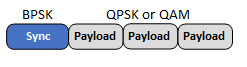
Data is packed into a transmission unit called a symbol, which contains a varying number of bits, depending on the number of subcarriers and the choice of the constellation used. Each set of symbols is prefixed with a specially design synchronization symbol, to align the receiver with the transmitter and correctly decode the symbol data. The synchronization symbol is always sent at the lowest bandwidth, and contains information about the number of data symbols in a transmission, which bandwidth has been used for the data portion. The figure below shows how the transmission is formatter.
Equalization
In any communications system the received data symbols are not the same as what left the transmitter, due to the characteristics of the radio and on-air channel. To correctly demodulate the data, a process known as equalization is applied to them prior to demodulation, which essentially ‘undoes’ what the channel and radio have added.
The process involves deriving a template of the frequency and phase perturbations, which is known as a training sequence. In and OFDM system, this information can be derived from the synchronization symbol, which can then be applied to all the subsequent symbols to restore the original symbol data.
This equalization is done on every received symbol, to consider different characteristics of each radio, as it is highly unlikely that any two radios will behave in the same fashion.
Testing
OFDM-AB has been tested on the following radios:
- FTM-3100
- ICOM IC-2000H, IC-2AT,
- Kenwood TK-760H, TH-D74, TK981, TKR-901
- Yaesu VR-120T
- TAIT TM-8100